
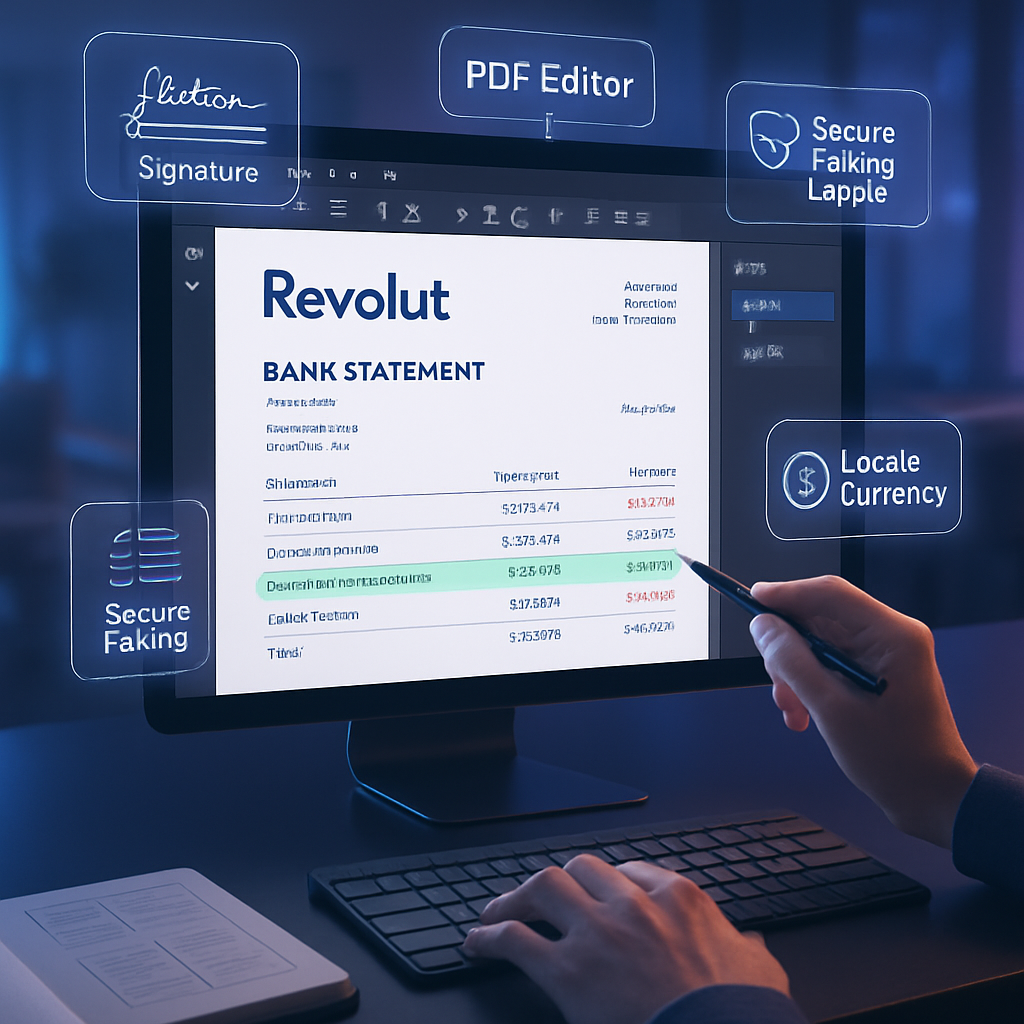
Editing bank statement templates like the Revolut bank statement template requires a careful balance between customization and preserving digital signatures to maintain document integrity. For anyone working with PDF bank statements from neo-banks such as Revolut and Monzo, understanding the unique design features and proper editing techniques ensures faster, consistent mockups with clean exports and correct locale formatting.
This guide covers essential methods for handling editable Revolut bank statement elements, including how to flatten digital signatures without invalidating them and adapting layouts typical of modern digital bank statements. You’ll learn to distinguish traditional from neo-bank formats and explore trusted template sources for reliable customization. Let’s explore how to efficiently edit and manage digital signature layers on Revolut and Monzo statement templates to produce professional, polished documents.
These templates are intended for design practice, mockups, and film props; they are not substitutes for official documents.
Understanding how to properly edit Revolut bank statement templates is essential for maintaining the integrity of digital signatures while customizing neo-bank proofs. This guide highlights key methods for professional handling of PDF bank statements, ensuring both authenticity in appearance and technical compliance.
- Recognize neo-bank statement characteristics: Familiarize yourself with design differences between Revolut and Monzo formats to create accurate templates.
- Preserve digital signatures during edits: Use specialized PDF editing tools that prevent signature invalidation when modifying statements.
- Apply digital signature flattening techniques: Understand how flattening converts signatures into static images, securing edits without breaking verification layers.
- Handle editable Revolut bank statement elements carefully: Customize text and figures while maintaining layout consistency to ensure readability and professionalism.
- Distinguish between traditional and neo-bank statements: Adapt your editing approach to the simpler, digital-first structure typical of modern banking proofs.
- Explore authentic template sources responsibly: Use verified collections of Revolut and Monzo statement templates as a secure foundation for your work.
- Hidden insight—technical nuance matters: Balancing visual customization with preservation of security features is crucial for credible neo-bank documentation.
Next, we will delve into step-by-step workflows for editing and flattening digital signatures on Revolut and Monzo PDF statements, ensuring your templates maintain both appearance and security. These templates are intended for design practice, mockups, and film props; they are not substitutes for official documents.
Understanding Revolut Bank Statement Templates
Editable document templates for Revolut bank statements are designed to replicate the clean, user-friendly layout typical of neo-banks. These templates emphasize minimalistic design, clear typography, and structured data presentation, which simplifies editing without overwhelming users with clutter.
Key Characteristics of Revolut and Monzo Statements
Revolut bank statements feature a sleek, modern interface with distinct color-coding for transaction types, a compact header containing account and personal details, and well-defined tables for transactions. Monzo shares some similarities but often uses brighter accent colors and slightly different typography. Understanding these subtle differences helps maintain authenticity when editing or customizing templates.
Key Revolut features include:
- A horizontal layout of user details and statement period for quick reference.
- Transaction tables sorted chronologically with date, description, and amount columns.
- Clear separation of credits and debits through color highlights.
Comparing Traditional vs. Neo-Bank Formats
Traditional bank statements rely heavily on tabular data with dense numerical information and multiple footnotes, often spanning several pages. By contrast, Revolut and Monzo utilize simplified layouts focusing on essential information with ample whitespace and intuitive sectioning. This digital-first approach reduces complexity during editing and enhances readability.
When working with templates:
- Expect fewer nested tables, making alignments easier to manage.
- Prepare for consistent font usage, often modern sans-serif families ideal for on-screen and print.
- Anticipate a limited color palette aligning with brand identity, simplifying color adjustments.
For users seeking to explore alternative neo-bank designs, Monzo Statement Templates provide an excellent comparison framework emphasizing similar usability principles.
Editing PDF Bank Statements Without Breaking Digital Signatures
Editable PDF bank statement templates must preserve their original integrity when modified, especially if they contain digital signatures intended for authenticity. Direct edits typically invalidate these signatures, making it crucial to apply careful techniques.
Challenges in Editing Digitally Signed PDFs
Digital signatures are cryptographic validations locked to document content at the time of signing. Even minor content changes, such as text adjustments or formatting shifts, can break this cryptographic hash, rendering the signature invalid. This challenge necessitates using editing workflows that either preserve signatures or flatten them post-editing.
Choosing the Right PDF Editing Tools
Not all PDF editors handle signed documents equally. Tools that allow non-destructive editing or support signature preservation modes are essential for professionals working with bank statement templates.
- Adobe Acrobat Pro DC: Offers redaction and minor edits while showing signature validity status.
- Foxit PhantomPDF: Supports layered editing and flattening for signature management.
- PDF-XChange Editor: Provides granular control over annotations and layers without disrupting signatures.
Selecting such tools reduces accidental signature invalidation and maintains document professionalism when customizing bank statement PDFs.
Best Practices for Text and Data Customization
When adapting textual elements or transaction data:
- Modify text fields designated as editable layers or form fields to avoid complex graphic edits.
- Maintain original font faces and sizes to preserve uniform appearance.
- Use locale-aware formatting for dates and currency to ensure clarity for end users.
- Preview the document thoroughly before exporting to avoid unintended layout shifts.
For direct downloads, Revolut Bank Statement Templates offer optimized files tailored for efficient customizations without compromising document integrity.
Digital Signature Flattening Techniques
In some workflows, flattening digital signatures enables users to customize PDFs freely post-signature while maintaining the signature’s visible appearance.
What Does Flattening a Digital Signature Mean?
Flattening converts interactive signature fields into static images within the PDF layer structure. This process locks the visual representation of the signature but removes its cryptographic verification capability, allowing edits to other parts of the document without invalidating the signature image.
Step-by-Step Guide to Flattening Signatures in PDF Statements
- Create a backup of the original PDF file to prevent data loss.
- Open the PDF in an editor supporting signature flattening (e.g., Adobe Acrobat Pro).
- Apply the flattening function, which typically merges signature layers with the rest of the document.
- Make required edits on the now-flattened document for text or layout.
- Save and review the final PDF to ensure the signature image remains clear and undistorted.
Benefits and Limitations of Flattening
While flattening preserves the visual authenticity of the signature for mockups and design purposes, it removes cryptographic proof, thus the document should not be used in situations requiring official verification. Flattened signatures support creative and educational uses by preventing accidental signature breakage during edits.
For convenient access to high-quality templates with flattening-ready signatures, consider German Revolut Statement Templates.
Handling Editable Elements in Revolut Bank Statements
Effectively managing editable fields within Revolut bank statement templates ensures the final output maintains its professional appearance and adheres to design standards.
Maintaining Layout Consistency and Readability
Focus on these key aspects when customizing statements:
- Use grid and alignment guides to keep transaction tables symmetrical and easy to scan.
- Preserve consistent margins and paddings around text blocks to avoid clutter.
- Adjust header and footer areas only within designated placeholders to maintain branding integrity.
These steps ensure that modifications do not disrupt the neat, spacious aesthetic typical of Revolut’s statements.
Customizing Currency, Dates, and Locale Formats
Adapting templates for various locales is crucial for user relevance:
- Apply locale-appropriate currency symbols and placement (e.g., £preceding the amount in the UK, €following in some European countries).
- Format dates following user region conventions (e.g., DD/MM/YYYY vs. MM/DD/YYYY).
- Use software features or scripts that automate number formatting for transactions to reduce manual errors.
Common Pitfalls and How to Avoid Them
- Mismatched fonts or colors: Stick to template defaults or use the exact brand colors to prevent an inconsistent look.
- Over-editing: Excessive modifications can cause the layout to break; always check alignment and conduct test prints.
For a curated selection of editable templates designed to minimize these risks, browse More Editable Bank Statement Templates.
Finding Authentic and Responsible Template Sources
Locating high-quality, reliable templates ensures users work with well-designed, accurate files suitable for their projects.
Reliable Collections of Revolut and Monzo Templates
Trusted providers curate collections that match current bank branding and provide formats compatible with Word, PDF, and PSD editors. Choosing established sources reduces the need for extensive modifications and ensures integrity in mockups, presentations, or educational demonstrations.
Legal & Ethical Use
- Templates should be used strictly for design practice, learning, mockups, or film and media props, supporting creative workflows.
- They must not be used as a replacement for official bank statements or any form of identity or financial verification.
- Respect copyright laws and the terms of service of template providers during customization and distribution.
Explore a wide range of compliant templates by visiting USA Revolut Bank Statement Templates for inspiration and hands-on editing.
Conclusion
Editable document templates for Revolut bank statements offer a streamlined approach to replicating modern banking documents with clarity and precision. By embracing minimalist layouts, consistent typography, and well-organized transactional data, these templates simplify the editing process while maintaining a professional and readable design. Understanding the nuances between neo-bank and traditional statement formats, alongside mastering PDF editing techniques—especially when handling digital signatures—ensures users achieve high-quality results without compromising document appearance.
Utilizing proper tools and best practices, such as preserving font consistency, respecting locale-specific formatting, and applying signature flattening when needed, enhances both efficiency and output reliability. These considerations help prevent common pitfalls like layout disruptions or signature invalidation, making template customization faster and more dependable.
Looking ahead, maintaining attention to detail with reusable templates not only supports consistent branding and accuracy across projects but also promotes seamless adaptation to multiple regions and formats. For anyone aiming to elevate their design workflows or educational mockups, leveraging professionally crafted Revolut bank statement templates is a practical step toward combining quality with speed.