
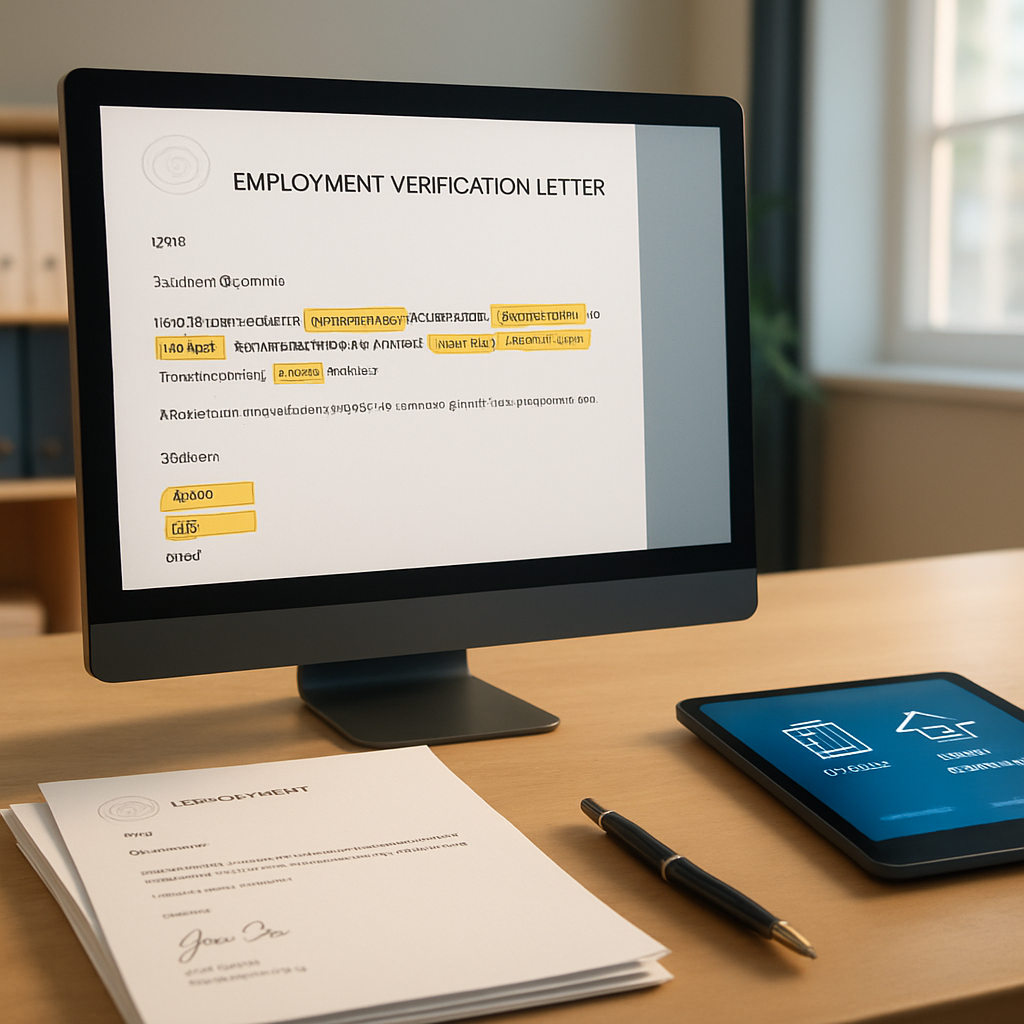
Creating a professional employment verification letter template ensures quick and consistent documentation when confirming job status for banks, landlords, or other organizations. Using an editable template speeds up the process, maintains clean formatting, and supports clear presentation of essential details like job title, employment dates, and salary information when needed.
This guide outlines how to customize and complete your employment verification letter accurately, providing free, easy-to-edit templates suitable for various verification contexts. You’ll learn key components to include, formatting best practices, and how to tailor the letter to different requirements such as banking or rental applications. Let’s explore how a well-crafted employment confirmation letter can streamline your documentation needs while maintaining professional standards.
Employment verification letter templates are essential tools for confirming a person’s job status in formal contexts such as banks and landlords. This guide breaks down key elements to include and how to tailor the letter for various verification needs.
- Clarify the letter’s purpose and scope: Define employment status, job title, and employment dates clearly to ensure the letter meets verification requirements.
- Include optional salary details when appropriate: Adding salary information upon consent enhances flexibility and aligns with legal standards.
- Identify common use cases: Banks, landlords, and background check agencies often require these letters as proof of employment eligibility.
- Ensure professional formatting and authenticity: Use company letterhead and authorized signatures to increase credibility and acceptance.
- Provide accessible, editable templates: Offering free downloads simplifies the creation of accurate letters tailored for different verifier needs.
- Address related questions proactively: Explain content requirements, requester roles, and formatting essentials to guide users effectively.
- Hidden insight—salary info adds compliance benefits: Incorporating optional salary data carefully supports broader use cases while respecting privacy.
Next, we will explore how to customize and fill out your employment verification letter template to match specific scenarios such as banking or rental applications. These templates serve as practical guides for official communication and should be used responsibly to maintain integrity.
Understanding Employment Verification Letters
Employment verification letters confirm an individual’s current or past job status in a formal and verifiable manner. These letters act as proof that an employee is actively engaged with an organization or has been employed during a specified period. Institutions like banks, landlords, and employers often require these letters to assess financial stability, reliability, or eligibility for certain services. Using editable document templates for employment verification letters simplifies the process by standardizing the format and information, enabling quick customization to suit specific use cases.
Purpose and Importance in Formal Contexts
Employment verification letters serve as authoritative documentation that supports applications requiring proof of employment. For example, lenders rely on them to assess income continuity before approving loans, while landlords use them to verify tenant stability. These letters help reduce ambiguity or fraudulent claims about employment status. The reliability of such letters often depends on clear, concise wording and accurate data, which editable templates help ensure by providing structured fields for all critical information.
Common Scenarios Requiring Employment Verification
Adjusting employment verification letter templates to suit different scenarios enhances their effectiveness. Typical instances include:
- Loan and mortgage applications, where financial institutions need assurance of employment stability and income.
- Rental and lease agreements, where landlords assess a prospective tenant’s ability to meet rent obligations.
- Background checks and employment eligibility verifications, especially for new hires or security clearances.
The specificity of information required varies per situation, so a flexible template structure facilitates easy edits without compromising professionalism.
Key Components of an Employment Verification Letter Template
Creating editable employment verification letter templates requires attention to essential content elements to maintain clarity and professionalism.
Defining Employment Status Clearly
Vital elements to clearly specify employment include:
- Job title: Accurate role designation to validate employee identity.
- Start and end dates: Exact employment period to establish tenure.
- Current employment status: Whether the employee is full-time, part-time, or contract-based, helping recipients understand job commitment levels.
Ensuring these details are placed in distinct, editable placeholders in templates accelerates editing and preserves uniformity across different letters.
Optional Salary Details with Consent
Including salary information enhances the document’s utility, particularly for financial verifications. However, to respect privacy rights and legal considerations, salary data should only be disclosed with the employee’s explicit consent. Editable templates should offer optional fields for salary that can be toggled on or off depending on the intended purpose. Clearly labeling these sections helps avoid unintentional disclosure during editing.
Professional Formatting Essentials
A professional employment verification letter must adhere to formatting conventions that reinforce authenticity:
- Company letterhead: Placing the company’s official header or logo at the top strengthens credibility and brand recognition.
- Authorized signatures and contact info: Dedicated sections for signatures of HR representatives or supervisors along with company contact details provide a point of verification.
- Date and reference number: Including the issue date and a unique reference or document number enables easy tracking or future queries.
Organizing these elements into editable layers in a template ensures quick updates without disrupting the overall design.
How to Customize Employment Verification Letter Templates for Specific Needs
Templates should be adaptable to cater to various recipients by adjusting focused content sections appropriately.
Tailoring Letters for Banks
When customizing for banking purposes, it is critical to emphasize salary details and employment stability because these factors influence loan approval decisions. Use templates with clear salary fields and employment duration prominently displayed near the top. Adding a short affirmation of employee reliability or good standing can further reinforce confidence.
Adapting Templates for Landlords
Landlord-directed verification letters prioritize consistent employment duration and income sufficiency. Salary fields may be included but often in a summarized or confidential manner to respect tenant privacy. Templates can include placeholders for the employee’s tenure and confirmation of ongoing employment, providing landlords assurance of rental payment capability without exposing excessive personal data.
Creating Versatile Employee Verification Letters
To maximize utility, develop templates with reusable editable sections such as employment dates, salary, and job title. Use layered text fields for rapid customization while locking branding and formatting layers to prevent unintended changes. Incorporating dropdown menus for employment status or salary type can minimize input errors and speed up letter generation.
Transitioning from content customization, it is equally vital to adopt best practices in writing and submitting these letters to maintain trust and professionalism.
Best Practices for Writing and Submitting Verification Letters
Ensuring Accuracy and Completeness
Accuracy is paramount to the credibility of employment verification letters. Before finalizing any letter, systematically:
- Double-check employee names, job titles, start/end dates, and employment status to avoid mismatches.
- Confirm explicit employee consent when salary disclosure is included.
- Apply uniform formatting standards across all letters to maintain a consistent company image.
Using editable templates with locked fields for static elements and clearly marked editable areas ensures fewer errors during composition.
Submission Guidelines and Follow-Up
Secure and professional delivery methods include sending letters through official company email accounts or sealed physical copies on letterhead. It is important to log all verification requests and responses to track status and ensure timely follow-up. Prompt responses increase institutional confidence in your organization’s administrative practices.
Having a reliable process from editing through submission heightens the overall perceived professionalism and accuracy of employment verification documentation.
Free Editable Employment Verification Letter Templates
Features of Our Available Templates
Our free editable templates offer:
- Predefined sections for essential employment details, salary fields, and company branding.
- Clean, professional layouts optimized for Word and PDF editing.
- Layered formatting to separate editable content from static branding elements.
These templates are designed for ease of customization to accommodate various verification scenarios without sacrificing appearance or clarity.
How to Download and Use Templates
- Download files in commonly used formats like DOCX and PDF for maximum compatibility.
- Edit fields directly in Word or using PDF editors to input specific employee data.
- Maintain document integrity by locking layers that must not be altered and saving finalized versions with clear file naming conventions.
Following these steps ensures polished, accurate employment verification letters ready for professional use across contexts.
Frequently Asked Questions About Employment Verification Letters
What Should Be Included in a Proof of Employment Letter?
Proof of employment letters should include the employee’s full name, job title, employment dates, current employment status, and optionally, salary details if consented. Company contact information and an authorized signature authenticate the document’s validity.
Who Typically Requests Employment Verification Letters?
Common requesters include banks, mortgage lenders, landlords, human resources departments for background checks, and government agencies for eligibility confirmation.
Is Salary Information Always Necessary?
Salary details are not always mandatory. Their inclusion depends on the verification purpose and whether the employee consents to disclosing that information.
Do Verification Letters Require Signatures or Letterhead?
Yes. Using company letterhead and attaching authorized signatures are best practices that lend legitimacy and prevent fraudulent use of verification letters.
Conclusion
Employment verification letters play a crucial role in confirming job status for a variety of formal needs, from loan applications to rental agreements. Using editable employment verification letter templates streamlines the creation process by providing standardized, professional formats that ensure key details—such as job title, employment dates, and status—are accurately presented. These templates enhance reliability by incorporating essential elements like company letterhead, authorized signatures, and optional salary disclosures, all of which can be tailored to meet the specific demands of institutions like banks and landlords.
Beyond consistency and clarity, editable templates offer significant benefits in efficiency, enabling rapid customization while maintaining clean formatting and locale-appropriate information. Their reusable components and locked design layers minimize errors during editing, supporting a seamless workflow that upholds professionalism across every verification letter issued.
For organizations aiming to maintain high standards and swift responsiveness, embracing these versatile templates represents a strategic step forward. By integrating best practices in document accuracy and submission protocols, companies not only enhance their administrative reliability but also foster greater trust among recipients. Exploring and implementing such editable templates can thus be viewed as a practical challenge to elevate document quality and operational agility in an evolving professional landscape.